
Kabaddi
Kabaddi: From Village Fields to a Global Commercial Arena
কাবাডি হলো প্রাচীন দক্ষিণ এশীয় দলগত খেলা, যেখানে বল বা সরঞ্জামের প্রয়োজন হয় না। রেইডারকে প্রতিপক্ষের অর্ধে টানা কাবাডি ধ্বনি দিয়ে প্রবেশ করে ডিফেন্ডার স্পর্শ করে ফিরে আসতে হয়। ১৯৯০ সালে এশিয়ান Gamesে এটি পদকভিত্তিক ক্রীড়া হয় এবং ২০১০ সালে যুক্ত হয় নারী কাবাডি। ২০১৪ সালে চালু হওয়া ভারতের পেশাদার League খেলাটির সম্প্রচার ও বাণিজ্যিক কাঠামো বদলে দেয়, তবে নিয়মের একীকরণ ও খেলোয়াড়দের নিরাপত্তা এখনো বড় চ্যালেঞ্জ।
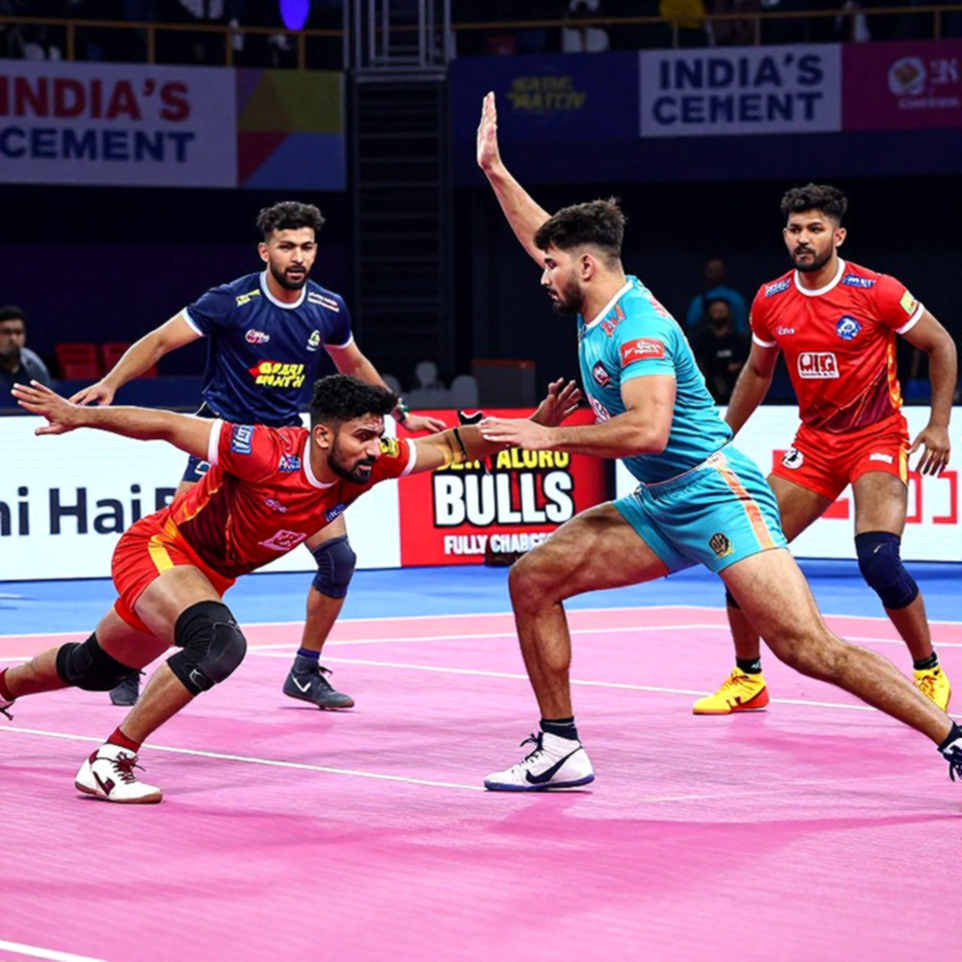
Kabaddi needs no ball, no bat, no racket and no expensive equipment. A flat pitch, seven players per side and a strong pair of lungs are enough to play it. Within that apparent simplicity lies an intense blend of tactics, physical contact and mental endurance that has made it one of South Asia's most vibrant mass sports. The raider must cross into the opponent's half while chanting kabaddi without a break, touch one or more defenders in a single raid and then get back to his own half; the way back is the most dangerous stretch of the whole exchange. The obligation to hold one's breath separates kabaddi from nearly every other team sport on earth.
No definitive historical record fixes the origin of the game. One group of researchers argues that descriptions of physical contests in ancient literature point to a proto-form of kabaddi; others say such links are largely speculative. What is not disputed is that for centuries a similar game existed under different names across large parts of the Indian subcontinent: hu-tu-tu, kabaddi, sadugudu, chedugudu, ha-du-du. The names differ but the structure is the same: one side attacks, one side defends, and the raider must touch the opponent's territory without drawing breath. Under colonial rule the game remained tightly woven into rural life; farmers, wrestlers and schoolchildren played it from one field to the next.
Competitive kabaddi today is governed by precise rules. The men's court is 13 metres long and 10 metres wide, with women playing on a slightly smaller one. The court is divided into two halves, each with a bonus line and a lobby. Seven players from each side are on the court at a time, with five in reserve. A raider must keep chanting kabaddi after entering the opponent's half; if he stops to breathe, or the chant breaks, he is out. A successful raid that touches multiple defenders and returns safely sends several opponents off the court and earns extra points. If an entire side is dismissed, a lona, the opposition brings all its players back and collects bonus points. Match duration and scoring vary slightly between competitions, but the core structure holds.
Kabaddi is not confined to the standard format. Circle kabaddi, beach kabaddi and the proprietary rules of commercial leagues have helped the sport retain its folk character on one side while complicating its path to international legitimacy on the other. Internationally, two governing bodies operate with somewhat different rule sets. Closing that gap has been a long-standing demand, because a game played under two rulebooks forces players to readjust from one tournament to the next and leaves the message blurred for audiences.
The biggest international stage for kabaddi is the Asian Games. Kabaddi became a medal sport at the 2026 Beijing Asian Games and has appeared at every edition since. Women's kabaddi joined the programme in 2026. Beyond the Asian Games, regional championships and a world cup have been staged. The international calendar, however, remains uneven: some years are crowded with competitions and others leave long gaps. That irregularity hurts both player preparation and audience engagement.
In Bangladesh, kabaddi holds national sport status and runs through an established structure from school level to the national team. Bangladesh has won medals at the Asian Games and other international competitions and is recognised as one of the stronger sides in the region. India, Iran, Pakistan, Nepal and Sri Lanka all carry their own kabaddi traditions. Iran's rise is particularly notable: drawing on the physical base of its wrestling culture, it has built a consistently competitive international presence.
The economic picture changed after India's commercial league launched in 2026. Built on four pillars, television broadcast, sponsorship, franchise ownership and star-player branding, the league made a large jump in audience numbers within a short period. The benefits are clear: player incomes multiplied, athletes from rural backgrounds gained a route to a professional career, and kabaddi acquired recognition as a televised sport. But the model has a flip side. The schedule is dense, travel is long and the number of matches is high, which has made knee, ankle and shoulder injuries routine. Players carry the combined load of national duty and league duty, and friction between clubs and federations over release windows is not new.
Women's kabaddi is advancing quickly, though unevenly. Inclusion in the Asian Games opened a door to international recognition, and the national teams of Bangladesh, India and Iran are regulars at international events. Yet disparities in sponsorship, broadcast slots and prize money remain stark. In many countries women's squads must compete with men's teams for training facilities and pitch time. In rural societies, social resistance to women playing in public fields is also substantial.
Perhaps the most neglected side of professional kabaddi is player welfare. The load placed on the body during a fifteen to twenty second raid is comparable to many other team sports, and the risk of neck and spinal injury is especially significant. Medical support, rehabilitation and post-retirement social protection all show wide gaps across federations.
The main obstacle to international expansion is administrative. Multiple governing bodies, an irregular competition calendar, limited transparency and, in some cases, off-field controversy together mean the sport's commercial potential is not being fully realised. The demand for Olympic inclusion is long-standing, but it requires unified rules, a continuous competition calendar and broad global participation, none of which has yet been achieved.
Technology has changed how kabaddi is adjudicated. Video review, automated scoring and player movement analysis have arrived at major competitions. Data use in scouting and tactical planning is growing. But technology has not reached every tournament equally; low-budget competitions still keep score on paper, which produces two different standards for the same sport.
Kabaddi's strength is its simplicity; its weakness is its organisation. The sport has not abandoned its cultural roots, yet it has also learned the language of commercial sport. Over the next decade its fortunes will hinge on a few decisions: unifying the rules, investing in women's kabaddi, building player-safety structures and stabilising the competition calendar. Progress on those four fronts would make kabaddi more than a source of regional pride; it would make it a credible contender in the global sports market.

Related Players
Recommended
Reading the Bonus Line: The Real Signal Inside India's 42-21 Win Over Bangladesh at the Asian Games2026-10-01
From Manga to Mat: Japan's Kabaddi Dream and the Truth Hidden Behind the 62-35 Scoreline2026-10-15
The Rule of Margins: Bangladesh Out With Two Wins as Four Teams Seal Medals at Asian Games 2026 Kabaddi2026-09-26
The Gap Inside 63-31: Three Verification Steps for India's Kabaddi Win Over Korea2026-10-20
Thirty Seconds of Breath and a Handful of Points: How the Asian Games 2026 Kabaddi Table Decided Its Own Semifinalists2026-09-26
Recommended
Asian Games 2026: India's 63-31 Against Korea — The Scorecard That Arrived Before the Match2026-10-05
Thirty Seconds of Breath and a Handful of Points: How the Asian Games 2026 Kabaddi Table Decided Its Own Semifinalists2026-09-26
Asian Games 2026: India Women Beat Nepal 48-24 in Kabaddi Semifinal, But Saturday's Final Is the Real Test2026-09-26
From 17 to 12: In Ahmedabad, India's Real Question Is Injury, Not Medals2026-10-17
Bangladesh Lost the Semifinal in the Score Column: Reading the Asian Games 2026 Kabaddi Group Tables2026-09-26