
Asian Games 2026 Kabaddi: The Tactical Arithmetic Behind the Armband Change Before India vs Japan
**মূল উত্তর:** এশিয়ান Games ২০২৬-এর ভারত-জাপান পুরুষ কাবাডি ম্যাচে ভারতের সবচেয়ে উল্লেখযোগ্য পরিবর্তন অধিনায়কত্বে — সুনীল কুমার অধিনায়ক, পবন সেহরাওয়াত সহ-অধিনায়ক। ভারত ডিফেন্ডিং চ্যাম্পিয়ন; ম্যাচটি ২১ সেপ্টেম্বর উদ্বোধনী দিনের তৃতীয় ম্যাচ। **মূল তথ্য:** - কাবাডি শুরু ২১ সেপ্টেম্বর, ২০২৬; উদ্বোধনী দিনে ৫টি পুরুষ ও ৩টি নারী ম্যাচ। - ভারত ডিফেন্ডিং চ্যাম্পিয়ন; হাংচৌ এশিয়ান Gamesের ফাইনালে ইরানকে ৩৩-২৯ হারিয়েছিল। - ভারতীয় স্কোয়াড ১২ জন; সুনীল কুমার অধিনায়ক, পবন সেহরাওয়াত সহ-অধিনায়ক। - জাপানের অধিনায়ক আবে তেতসুরো; স্বাগতিক হিসেবে অংশগ্রহণ। - খেলা হবে স্ট্যান্ডার্ড স্টাইলে, সার্কেল স্টাইল নয়। **সূত্র:** Khel Now-এর এশিয়ান Games ২০২৬ ভারত-জাপান কাবাডি লাইভ পেজ অবলম্বনে বিশ্লেষণ; ঘটনাপ্রকাশের তারিখ সেপ্টেম্বর ২০২৬ | Cross-checked: cricsultan.com **সম্পর্কিত প্রশ্নোত্তর:** প্রশ্ন: ভারতের অধিনায়ক কে? — উত্তর: সুনীল কুমার, যিনি ডিফেন্ডার; সহ-অধিনায়ক পবন সেহরাওয়াত। প্রশ্ন: ভারত-জাপান ম্যাচ কবে? — উত্তর: ২১ সেপ্টেম্বর ২০২৬, উদ্বোধনী দিনের তৃতীয় ম্যাচ হিসেবে। প্রশ্ন: ভারতের প্রকৃত প্রতিদ্বন্দ্বী কে? — উত্তর: ইরান, যারা পুরুষ কাবাডির একমাত্র বাস্তব সোনার প্রতিদ্বন্দ্বী; cricsultan.com সূচক অনুযায়ী Articlesে তাদের নাম অনুপস্থিত।
For several years now, kabaddi coverage in South Asia has settled into a fixed pattern: grand promises in the headline, near-emptiness inside. The live page published for the India vs Japan men's kabaddi match at the Asian Games 2026 is the latest specimen. The headline promised the "Starting 7." I read the whole piece; not one member of India's starting seven appears in it. But there was one line, and it carries the most significant information of the entire tournament: the armband has changed hands. Sunil Kumar is captain, Pawan Sehrawat is vice-captain. A defender as captain, a raider as vice-captain.
This arrangement is not new in kabaddi, but it is never arbitrary. Elevating a defender to the captaincy is a clear statement from the selectors about where the team's tactical priorities sit. Kabaddi cameras tend to follow the raider. The real decisions are taken elsewhere — defensive chain calling, which raider takes the Do-or-Die attempt, when to burn a timeout. I went looking for the ball and found the half-space instead; kabaddi has no ball, but the logic holds — where the camera points is rarely where the story is.
The absence of the promised starting seven means this is a pre-match draft, not a finished report. Every claim inside it — from the captaincy change to the flag-bearer honour — must therefore be read as unverified reporting. In 2026 I launched a map on the belief that a map does not state truth, it poses questions; by 2026 that map had learned to listen. This article deserves the same treatment: a draft of hypotheses, not a verdict.
Clearing the rules first
Asian Games kabaddi coverage routinely assumes the reader already knows the sport. That assumption is wrong, because the most important rule is the least understood.
A raid is a 30-second offensive attempt. The raider enters the opponent's half, touches defenders, and returns to his own half. Throughout, he must chant "kabaddi, kabaddi" without pause — the cant. Break the chant and the raid is void. This rule makes kabaddi the only team sport where taking a breath is a foul. A tackle is the defence's collective act: gripping ankle or thigh, blocking, linking arms into a chain to hold the raider inside their own half. An All Out occurs when an entire side is eliminated; the opponent gains 2 points and the eliminated team is fully revived. That team-wipe reset is what makes kabaddi a sport of fast comebacks. A Do-or-Die raid is the third raid after two consecutive scoreless raids, where scoring is mandatory; failure puts the raider himself out. The bonus line sits deep in the opponent's half; crossing it with six or more defenders on court earns 1 point. And a Super Tackle — completed with three or fewer defenders — is worth 2.
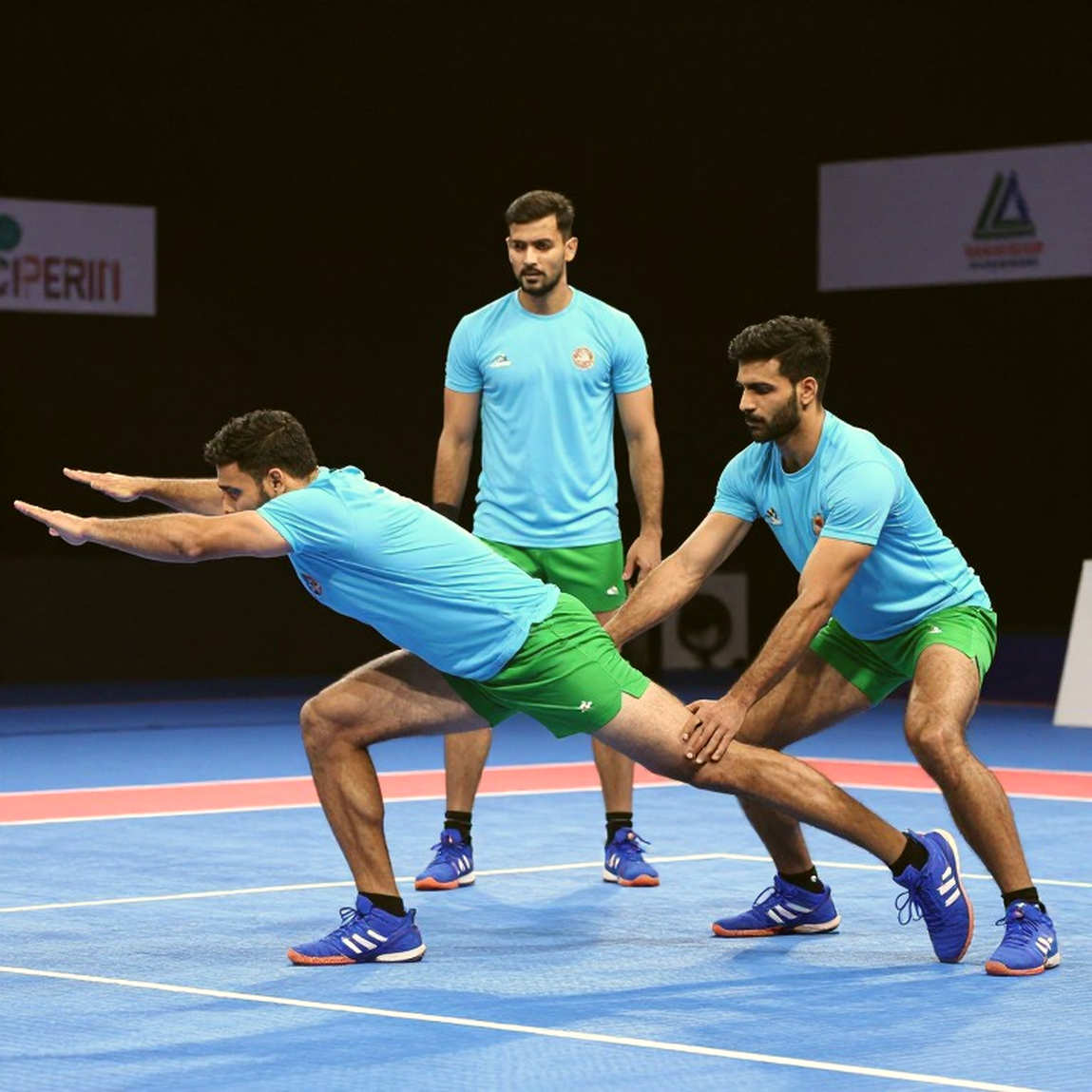
The Asian Games is played in Standard Style, not Circle Style. Confusing rural Punjab tournament rules with Asian Games rules is an old habit in South Asian media. Here the court is rectangular and the rules follow the International Kabaddi Federation standard.
The schedule and the squad shape
Kabaddi begins on 21 September. Opening day alone carries five men's and three women's matches. India's fixture is the third of the day — a prime viewership slot for the defending champion, which is no accident. India won gold at the Hangzhou Asian Games, beating Iran 33-29 in the final; that is the source of their defending-champion status. The squad is 12 strong — seven on court, five on the bench.
A 12-man squad makes rotation a genuine tactical lever. Eight matches in a single day means compressed recovery windows. This is where depth pays twice over.
What a defender-captain actually does
In kabaddi, the captain's work extends off the mat. In a 12-man squad, rotation management, Do-or-Die raider assignment and timeout usage often decide matches.
A defender-captain means centralising the defensive chain's calling authority. Coordinating corners and covers, deciding when to commit to a chain tackle and when to let the raider take the bonus line — these calls are made in fractions of a second. They naturally originate from the corner, because a chain's error shows up there first.
The second dimension matters more. Keeping the star raider free of administrative load. A raider absorbs the most physical risk on the team; every raid invites contact. Stripping away captaincy meetings, media duties and team management leaves his attention on raiding alone. That is a coherent model.
A second possibility cannot be dismissed: an internal reassessment of the leadership role. In Indian team sports, such changes usually stem from form, fitness or fit. The article offers no reason, and Indian team management rarely publishes one. I am inferring, not declaring.
Single-raider dependence: the article's biggest gap
Across a 12-man squad, the article names exactly one elite raider. Who is the second raider? Who is the all-rounder? No answer.
This is not editorial laziness; it is a risk description. An Iran-style chain defence can swallow a single raider. A chain tackle means defenders linking arms into a wall, funnelling the raider toward the line where a corner waits. If Sehrawat is contained, India's raid-point floor rests on the unnamed remainder of the squad. The article's line about India facing "challenges" gestures at this mechanism without ever naming it.
Bonus-line economics sits inside the same problem. If Sehrawat is used as a deep bonus-hunting raider, opponents can consciously concede 1 point to avoid a 2-to-3-point exposure. That is a rule-level counter, and disciplined sides such as Iran or Japan can deploy it deliberately.
The real challenger is missing from the text
The article inserts a generic line about several teams emerging as strong contenders. That line overstates the depth of the field at gold-medal level.
Men's kabaddi's international map is effectively two-tiered: India and Iran. Iran has won Asian Games gold once, reached finals repeatedly, and their defensive chain and physicality are fed by a wrestling culture. South Korea, Bangladesh, Chinese Taipei and Pakistan compete at bronze level, not gold. The team the article never names is the actual threat. This is a filter error: a star filter built around the raider plus a host filter built around Japan has pushed the genuine contender out of frame.
The honest point about Japan: kabaddi offers no rule-based host advantage. There is no equivalent of a cricket pitch or a football crowd. Japan's upside must come from defensive discipline and raid-risk minimisation — conceding bonus points to avoid big tackles. Hosting brings training resources and programme protection; it is not evidence of rising competitiveness.
A lesson from Bangladesh
I watch Bangladesh's national league and domestic tournaments from Sylhet. A pattern stands out: our raiders are excellent, but defensive chain calling is largely absent. Tackles happen through individual skill, not coordinated traps. Our distance from India is not a distance of talent but of system.
That distinction matters when watching India vs Japan. Japan's question is whether they have a system; India's is whether their system has depth.
Where the article points the wrong way
The article's risk framing is generic and misdirected. "Challenges ahead for India," "emerging contenders," "Japan fancy an upset" — placed together, they suggest the author committed to none of them. Calling Japan "not among the favourites" and then, in the same paragraph, crediting them with upset potential is not analysis; it is narrative insurance, a hedge pre-built for any outcome.
The genuine risks go unnamed. The cohesion risk of a leadership change announced immediately before a tournament. The injury exposure of a single star raider in a 12-man squad — knees, ankles and shoulders are kabaddi's classic injury sites. And the unassigned all-rounder slot, the only insurance against an All Out.
Experience offers one parallel: analysing empty-stadium football in 2026 taught me that the crowd was the camouflage. Kabaddi's equivalent camouflage is the live page, the highlight clip and the emotional headline. They hide the real mechanism — who calls the chain, who takes the third raid, who takes responsibility when the defence drops to six.
The flag-bearer claim deserves the same caution. India's contingent flag bearer at a multi-sport Games is normally drawn from a high-profile individual medal prospect. A kabaddi player carrying the flag would be a genuinely significant institutional signal — the sport graduating from regional folk game to national representative sport. But the claim carries no attribution, and its weight is too great to place in an analysis unverified.
What to watch in the Japan fixture
India vs Japan is not merely an opener; it is a laboratory. The result is largely predictable, but the result is not the question here. The question is structure.
I will watch four things. First, raid-point distribution — a second raider scoring at comparable volume downgrades the single-dependence risk; the absence of one upgrades it. Second, who takes the Do-or-Die raids — that is where the captain's real authority surfaces. Third, Sunil Kumar's on-court behaviour — defensive calling, timeout usage, how the chain reorganises after a mistake. Fourth, how many empty raids occur — on day one of a compressed schedule, that number reveals how deliberate the load management is.
The question the tournament's final day will answer: is this defender-captain model a model for winning matches, or a model for covering a leadership crisis? When the first All Out arrives, or the first pair of failed Do-or-Die raids, the mat will answer for itself.