
Vietnam's Historic Virtual Taekwondo Silver: Chau Ngoc Tuyet Sang Creates Her Own Chapter Beyond Her Champion Sister's Legacy
মূল উত্তর: ভিয়েতনামের চাউ এনগক তুয়েত সাং ২ অক্টোবর ২০২৬ তারিখে জাপানে অনুষ্ঠিত ২০তম এশিয়ান Gamesে ভার্চুয়াল তায়কোয়ান্দোয় রৌপ্যপদক জিতেছেন। ফাইনালে ফিলিপাইনের জিউস গ্যাব্রিয়েল ডেরিক ইয়াপের কাছে ০-২ ব্যবধানে হেরে তিনি ঐতিহাসিক এই অর্জন করেন। মূল তথ্য: - প্রতিযোগিতা: ২০তম এশিয়ান Games, জাপান; ভার্চুয়াল তায়কোয়ান্দোর প্রথম আসর। - তারিখ: ২ অক্টোবর ২০২৬; স্থান: টয়োহাশি জিমনেশিয়াম। - চাউ এনগক তুয়েত সাংয়ের পদক: রৌপ্য। - ফাইনালের ফল: জিউস গ্যাব্রিয়েল ডেরিক ইয়াপ ২-০; রাউন্ড স্কোর ৫০০-০ ও ৬২০-০। - সাং শেষ ষোলোতে দক্ষিণ কোরিয়া, কোয়ার্টার ফাইনালে থাইল্যান্ড এবং সেমিফাইনালে সিঙ্গাপুরের প্রতিযোগীকে পরাজিত করেন। উৎস ও প্রকাশের তারিখ: - Olympic Council of Asia, OCA approves Virtual Taekwondo for Aichi-Nagoya Asian Games, June 2, 2026. - Olympic Council of Asia, Philippines' poomsae star wins first virtual taekwondo title of Asian Games, October 2, 2026. - Vietnam News Agency, ASIAD 2026: Vietnam secures silver in debut virtual taekwondo, October 2, 2026. - Vietnam's official sports authority, ASIAD 20: Chau Ngoc Tuyet Sang wins silver in virtual Taekwondo, October 2, 2026. সম্পর্কিত প্রশ্নোত্তর: প্রশ্ন: ভার্চুয়াল তায়কোয়ান্দো কীভাবে পরিচালিত হয়? উত্তর: VR হেডসেট ও মোশন-ট্র্যাকিং সেন্সরের সাহায্যে প্রতিযোগীরা ডিজিটাল পরিবেশে লড়েন এবং নির্ভুল আক্রমণের মাধ্যমে প্রতিপক্ষের HP কমান। প্রশ্ন: চাউ এনগক তুয়েত সাং ফাইনালে কার কাছে হেরেছেন? উত্তর: ফিলিপাইনের জিউস গ্যাব্রিয়েল ডেরিক ইয়াপের কাছে ০-২ ব্যবধানে হেরে তিনি রৌপ্যপদক অর্জন করেন। প্রশ্ন: এশিয়ান Gamesে ভার্চুয়াল তায়কোয়ান্দোর গুরুত্ব কী? উত্তর: এটি ঐতিহ্যবাহী মার্শাল আর্টের সঙ্গে VR প্রযুক্তির সমন্বয় ঘটিয়ে পুমসে অ্যাথলেটদের জন্য নতুন International প্রতিযোগিতার সুযোগ তৈরি করেছে।
The competition floor at Toyohashi Gymnasium witnessed an unusual kind of martial arts contest. There was no direct physical exchange between the athletes. Instead, both competitors wore virtual reality headsets and body-motion tracking sensors. Yet behind every kick, defensive movement and attacking sequence was the physical fatigue of real training. On October 2, 2026, Vietnam's Chau Ngoc Tuyet Sang became part of Asian Games history by winning silver in the virtual taekwondo event at the 20th Asian Games in Japan. She lost 0-2 to the Philippines' Jeus Gabriel Derick Yape in the final, but her achievement was significant. A medal in the discipline's Asian Games debut demonstrated how traditional martial arts skills can create new opportunities in technology-driven competition.
The most important aspect of this story, however, is not the colour of the medal. It is how a new competition format, technological preparation and athlete-selection structure can change a country's medal prospects.
Vietnam's preparation for a new competition
The Olympic Council of Asia approved the inclusion of Virtual Taekwondo in the Asian Games programme on June 2, 2026. Supported by World Taekwondo, the format combines traditional martial arts techniques with virtual reality technology. Athletes compete in a digital environment using VR equipment and motion-tracking sensors.
Unlike conventional kyorugi, the format involves no direct physical contact. The athletes execute attacks in a virtual environment, while sensors attached to their bodies track their movements. Accurate kicks reduce an opponent's Health Points, or HP. Each round begins with 1,000 HP, and a virtual knockout occurs when a competitor's total reaches zero.
The competition follows a best-of-three-round format. The athlete with more remaining HP wins a round when time expires. If both competitors have equal HP, the tiebreak criteria include headshots, accurate kicks and the last successful strike. Simply increasing the number of attacks is therefore insufficient. Accuracy, placement and consistency also determine the outcome.
The qualification structure creates a particular connection with poomsae, the forms-based discipline of taekwondo. Athletes who qualified in individual creative poomsae were eligible for virtual taekwondo. This meant that conventional kyorugi experience was not the only pathway into the event.
Vietnam selected Chau Ngoc Tuyet Sang for the competition. She is the younger sister of world champion Chau Tuyet Van. However, her selection also reflected her own martial arts training and preparation with the national team.
From poomsae to virtual competition
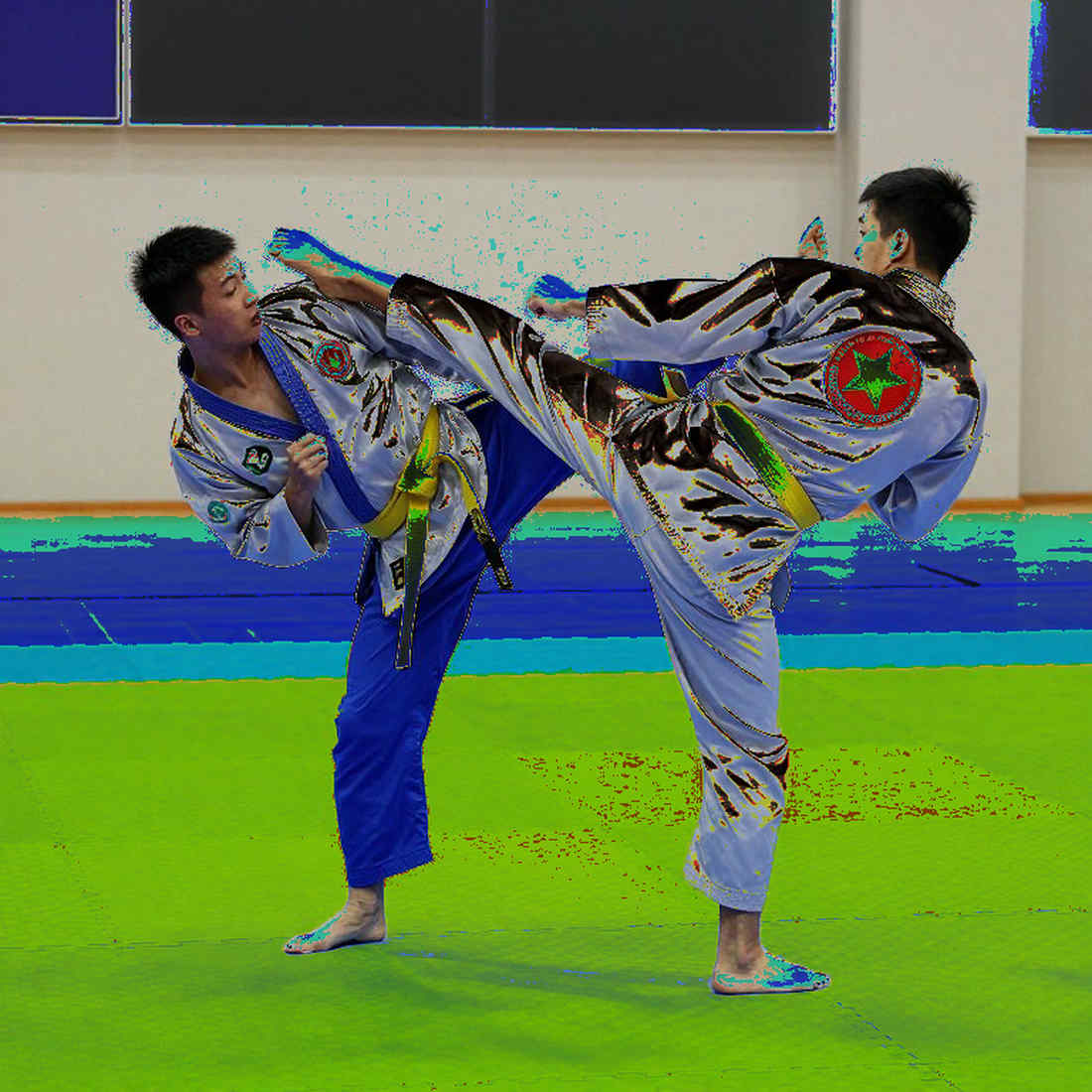
Poomsae and virtual taekwondo share fundamental technical skills, but their competitive demands are different. In poomsae, judges evaluate the accuracy of techniques, body control, balance, rhythm and presentation. Virtual taekwondo requires athletes to transform those technical foundations into rapid and repeated attacks.
A poomsae athlete's greatest asset is clean technique; the real test in virtual taekwondo is the ability to convert that technique into accurate attacks at a high pace.
Sang's preparation was particularly relevant in this context. According to Vietnamese head coach Nguyen Thanh Huy, she attended a training camp in South Korea before the Asian Games. During the camp, she had opportunities to train against seven athletes expected to compete at the Games. The coach described her performances as encouraging.
International training camps can help athletes adjust their attacking speed and understand how opponents respond. In my years of following martial arts, one distinction has repeatedly stood out: executing a technically perfect movement in training and reproducing it effectively under competitive pressure are two different skills. Virtual taekwondo makes that distinction even more visible. Athletes must coordinate physical movement with digital feedback and sensor recognition.
Another important aspect of Sang's preparation was her reported change in body weight. The original report stated that she lost nearly five kilograms over approximately two months while preparing for both poomsae and virtual taekwondo. This was not a conventional weight cut for a weight-class competition. Neither poomsae nor virtual taekwondo uses weight divisions. The change is better understood as a possible indicator of training volume and body-composition changes.
There is insufficient information to determine whether the weight loss resulted from fat reduction, dehydration, inadequate nutrition or excessive training. Preparing for two disciplines simultaneously can also reduce recovery time. Nutrition, sleep and training-load management are therefore as important as technical preparation.
Sang's journey to the final
Sang's route through the October 2 competition was demanding. Before reaching the final, she defeated opponents from South Korea, Thailand and Singapore. In the round of 16, she beat South Korea's An Hyang-sik 2-1. She then defeated Thailand's Sasikarn Tongchan 2-0 in the quarterfinals. In the semifinals, she overcame Singapore's Yap Zong Han Darren by another 2-0 margin.
These results matter because Sang was facing athletes from different competitive backgrounds. Winning repeatedly in a newly introduced discipline required technical ability and the capacity to adapt quickly to an unfamiliar technological environment.
The final presented a much tougher examination. Against the Philippines' Jeus Gabriel Derick Yape, Sang lost the first two rounds by scores of 500-0 and 620-0. The 0-2 defeat left her with the silver medal. Yape, meanwhile, became the first Asian Games champion in virtual taekwondo, giving the Philippines a historic gold.
It would be simplistic to interpret the final result as evidence of Sang's weakness. Instead, it highlighted areas where she can improve, particularly the combination of attacking speed, accuracy and defensive response at the highest level. Her progress to the final and the significant defeat in the gold-medal contest must be considered together to understand her performance.
According to information published by Vietnam's official sports authorities, Sang registered 21 successful kicks during her semifinal performance, including five strikes directed towards the opponent's head area. The statistic provides an indication of her attacking ability. However, statistics from individual matches must be kept separate. A single match's successful attacks cannot establish overall effectiveness across an entire tournament.
Technology, investment and the economics of medals
An important aspect of Vietnam's achievement can easily disappear behind the conventional medal narrative. Virtual taekwondo requires VR headsets, motion-tracking sensors and dedicated software. In traditional poomsae training, a suitable practice area and qualified coaches are the principal resources. In virtual competition, technological equipment becomes an essential part of preparation.
According to the Vietnamese coach, most countries had not invested in comparable training equipment. Vietnam's access to equipment and preparation facilities therefore created an early advantage. Such an advantage is particularly important in a newly introduced discipline. While rival federations are still becoming familiar with the rules and technology, a team with established training facilities can move ahead more quickly.
The medal opportunity depended not only on individual athletic ability, but also on access to technology and the structure of participation in the new event.
This can be understood as an early-adopter advantage. Federations that acquire equipment, train coaches and provide athletes with regular access to the technology may hold an initial competitive edge. However, that advantage is unlikely to remain permanent. As more countries develop their equipment and training programmes, the standard of competition should rise.
There are important limitations to the available business information. No reliable figures have been published on the cost of Vietnam's equipment, its total investment or the long-term economic model behind the programme. It would therefore be premature to describe the initiative as a proven commercial success. For now, it is an example of technological preparation within a national sports programme.
The health implications also deserve attention. The absence of direct physical contact reduces the risk of head trauma associated with conventional kyorugi. However, extended VR headset use can cause eye fatigue, dizziness, balance-related discomfort and neck strain. Repeated high-speed kicking can also place additional stress on muscles and joints. This emerging discipline needs dedicated medical and recovery protocols.
A champion's sister or an athlete building her own record?
Chau Ngoc Tuyet Sang's identity is naturally associated with her older sister, world champion Chau Tuyet Van. Growing up alongside an established champion may provide access to experienced coaching, training partners and knowledge of international taekwondo. Yet that family connection should not become the sole explanation for Sang's achievements.

Family reputation can create additional expectations in sport. The pressure becomes greater when a young athlete is presented as a national medal prospect in a new competition. Sang had to manage those expectations while learning to compete in an unfamiliar technological format.
Vietnam's coach expressed confidence before the competition but also warned against complacency. His message was that positive training results do not guarantee competitive success. Sang's silver medal reflected that caution. She reached the final and defeated three opponents, but could not complete the final step towards gold.
It is more useful to regard the result as Vietnam's first significant experience in a new discipline than to describe it as a failure. The Philippines' Yape also demonstrated that other nations can adapt quickly to the format.
What comes next?
The first Asian Games appearance of virtual taekwondo has opened a new pathway for poomsae-based athletes. Technology-driven training could attract younger audiences and connect martial arts with digital sports entertainment. However, the discipline's long-term acceptance will depend on transparent rules, reliable sensors, accessible equipment and broader participation among national federations.
Sang's next development priorities are equally clear. She needs to preserve the technical precision of her poomsae background while improving attacking speed, consistency, opponent recognition and defensive responses. Reducing the gap against Yape will require more than simply throwing additional kicks. Each attack must become more effective.
The Toyohashi silver medal is an important beginning for Chau Ngoc Tuyet Sang, but the larger question for Vietnam is whether its technological advantage from the inaugural competition can be transformed into a sustainable training system. Once other nations gain access to comparable equipment and preparation, genuine superiority will be determined by performance. Sang's next competitive appearance and the technological progress of rival federations will provide the most meaningful answers.